Defining a product so it stands above the crowd — Beam.gg Gamification Strategy
The big one about Beam.gg’s defining feature and how we got there — see Product Design and Website and Brand Identity for the eye-candy.
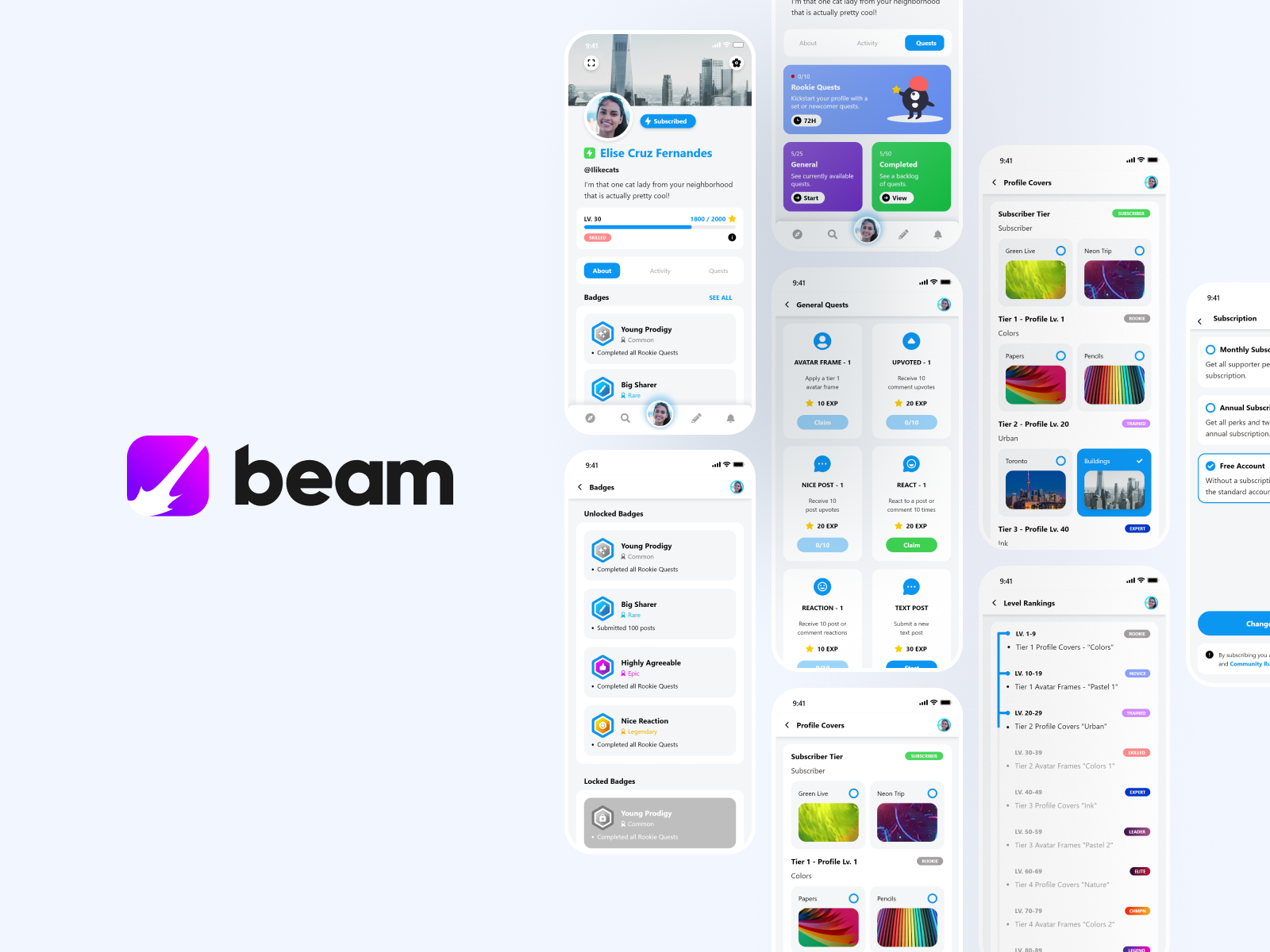
From regular platform to a big increase in conversion and a majorly successful early-access campaign.
That’s the gist of my 2020 to 2022 working as the solo designer on Beam.gg, a B2B2C online community platform built by a team of less than five. Making gamification its forefront was the insight the product needed, increasing conversion by over 30% on A/B tests, and earning us an invite to the exclusive AppSumo Select campaign.
From early planning to designing and prototyping, we’ll dive into how I helped introduce gamification into the platform, making it its defining feature and giving users a promising alternative over well-established competitors.
We tackled a problem that already had a solution.
Beam.gg came to life from the pandemic-driven boom in online communities — but the challenge was never building a platform. Online communities have existed since forums and IRC; the real issue is that they all offer the same old toolkit.
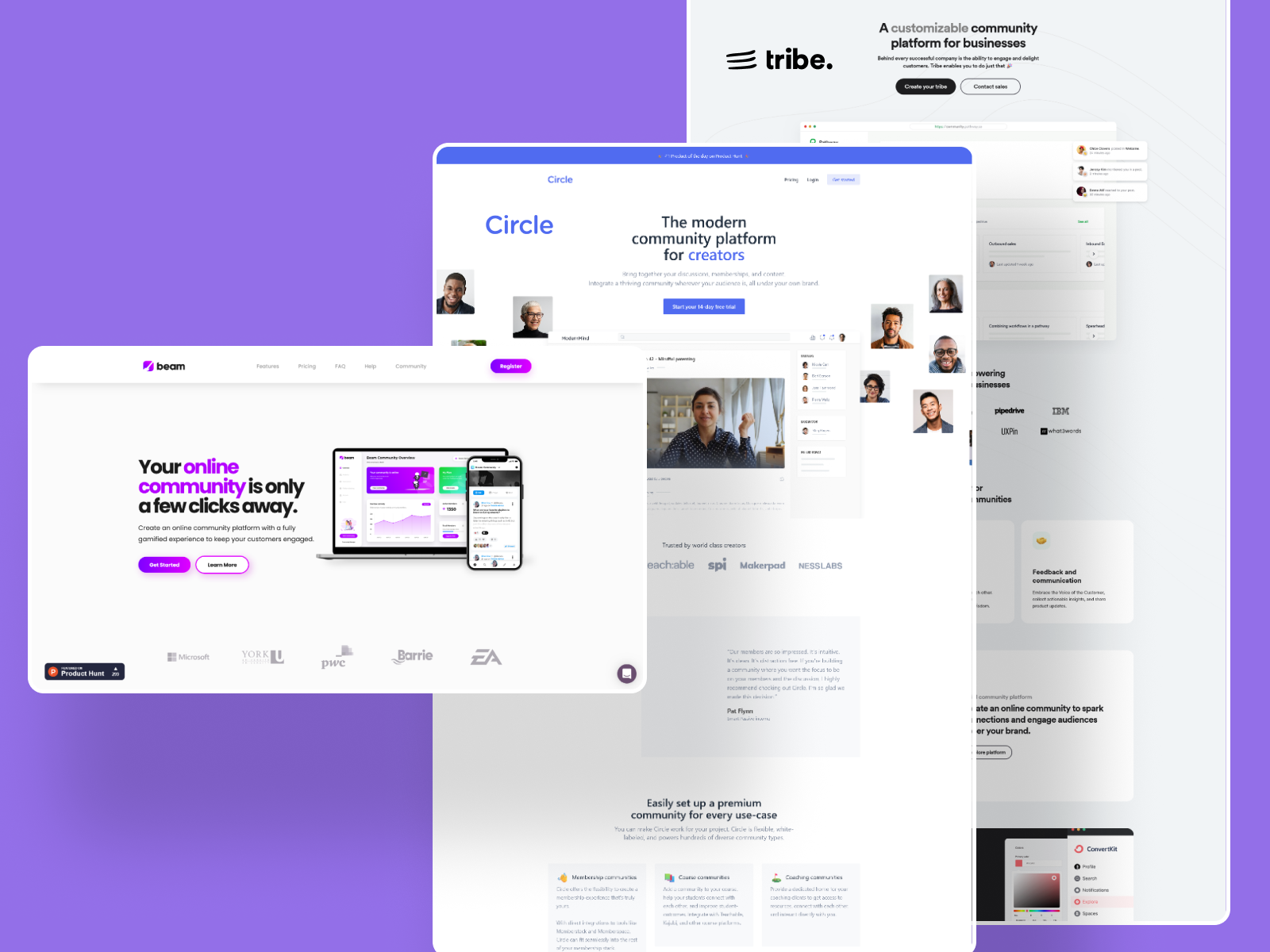
We started as a forum-based system with private ownership, which separated us from regular social media but put us right next to established platforms like Circle and Tribe.
Being a small but strong start-up with less than 5 members, we knew the standard toolkit alone wasn’t enough. Our product needed a hook to stop people from choosing the bigger, more polished and mature competitors.
Gamification created retention and engagement, for B’s and C’s alike.
Growing up with video-games, I was already familiar with gamification before even knowing the term, but during research I understood the true power of gamification and how positively it affects products.
From drastic increases in engagement and retention, to boosted productivity and task-completion in large companies. Those are only some of the success stories that involve gamification and its applications.
With that much personal connection and proof of success, it felt only natural to design the product with a strong emphasis on gamification.
After a quiet soft-launch, the feedback we got from customers — aside from bug reports and general feature requests — was a positive outlook on the gamified features. Being a small team, I was part of the direct Intercom support, and without a formal R&D process, hearing directly from the people using the platform was incredibly valuable to understand what people actually wanted and what the product truly needed.
This was a signal that the gamification we had was a good foundation, but it was only later that we shifted the product’s identity to having gamification at its forefront, which gave us a massive increase in conversion and a wildly successful AppSumo campaign. We still had a ways to go, and the multi-year journey happened one step at a time.
Implementing and presenting gamified features in a compelling way wasn’t easy.
Even a basic, run-of-the-mill upvoting system can be considered gamification. That one is the easy part that only scratches the surface. The hard part of gamification is the features that require a long-term presence, and ensuring those features are working in tandem as part of a large structure is what makes or breaks it.
As just mentioned, we started with a basic upvote system as the basis for the user interaction within the community. A user would create a new thread and others could upvote or downvote to generate engagement and impact that post’s position in the community’s feed. That’s the tray that held the cake in place. We later also introduced Reactions, which was a way for users to further express their feelings on a post or comment, and we got great customer feedback from it, especially from community owners once we allowed them to customize the reaction icons and naming.
User profiles and the features we built for them made up the base of the cake. Profiles didn’t simply have an upvote counter, we created an entire Leveling system that tied together several other important features, such as Quests that gave users big and small objectives — like submitting a comment or upvoting a post — which would earn them Experience points, building up towards their Profile Level.
One important aspect about Quests was letting users claim the experience points for themselves. After meeting the requirements, the user would get a notification of Quest Completion, and on the Quest board they would claim the quest bounty, which gave a strong sense of accomplishment instead of simply seeing a number go up without action.
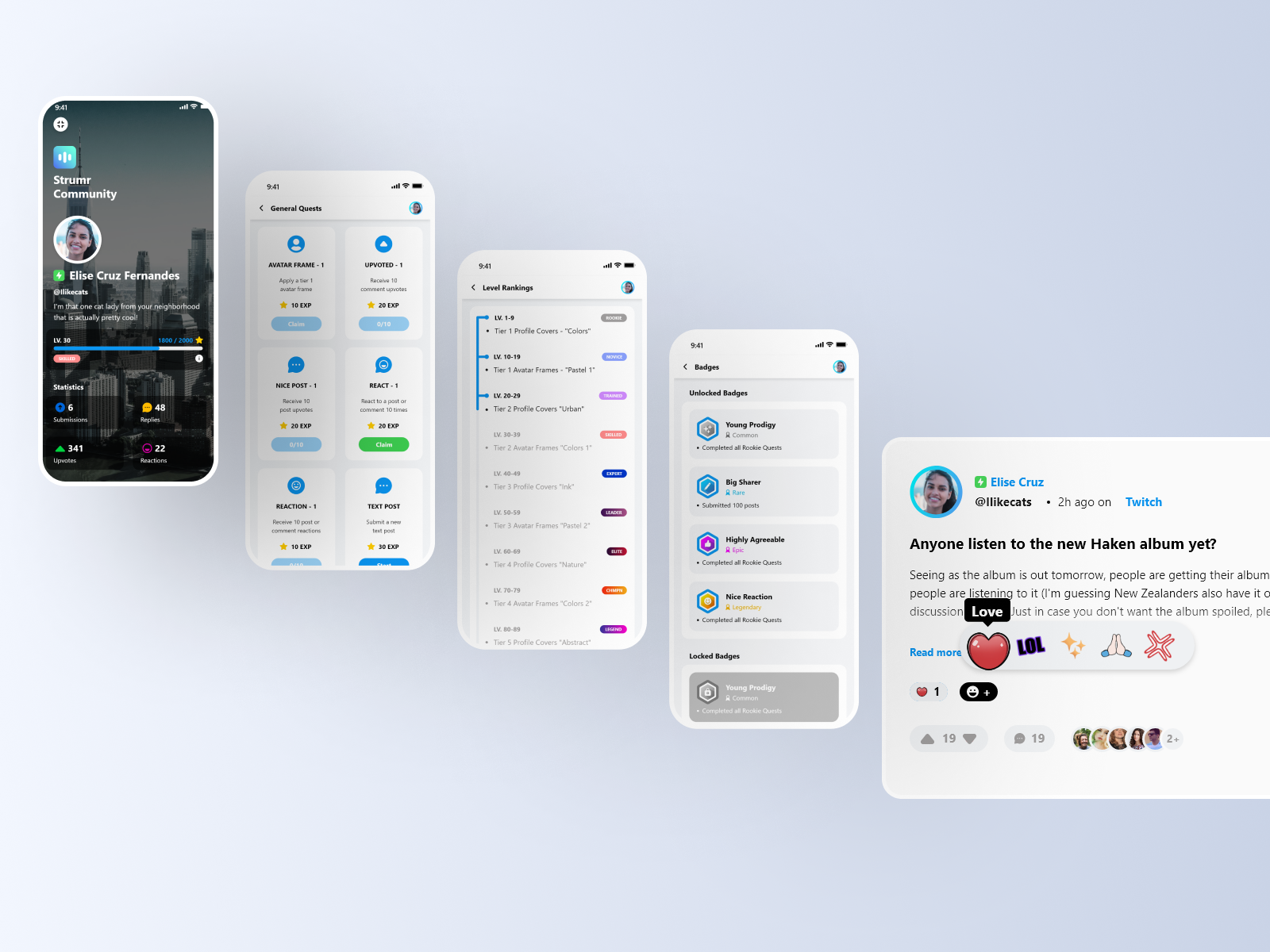
Aside from giving users bragging rights, Profile Level is a bit artificial without proper rewards. Having played many online games in the past, one of the ways I knew to create meaningful progression was to offer clear milestone rewards that can be shown to other users. I landed on profile customization tied to the profile level — those being Avatar Frames and Profile Covers — which not only gave meaning to leveling up but also a way for users to express and showcase said progression. We also added Badges (commonly known in gaming as Achievements) that were awarded after a specific objective or set of quests was complete.
Creating the profile customization was a challenge in itself. With highly limited resources, I put a lot of thought into making interesting visuals that people would actually strive to obtain. One of the things I really wanted to introduce was Animated Customization, which had to be crisp enough to look good but lightweight enough to not impact performance.
The final implementation for the animated rewards required a very precise process. First, since the project was on a tight budget, I had to find royalty-free resources I liked well enough to use. After having a good video, I created a masked overlay on Photoshop and exported the loop in individual frames. With a few dozen frames exported, I would run them into an APNG (Animated PNG) program that would turn those loose frames into a crisp, transparent and lightweight file that could be used in the project.
We also introduced Engagement Leaderboards, which would display to the whole community the top most active users, creating yet another layer of bragging rights and incentive for users to interact. This and other features we implemented over time made for the rest of the cake.
All of this effort added up to give us our big breakthrough.
Following the soft-launch, the team started to push towards more broad social media presence with a greater emphasis on ratings websites. We had a small but still successful Product Hunt release, earning us a solid 4.9/5 score in over 25 reviews. We also got a 4.7/5 in over 10 reviews on Capterra. But our big day would happen later, and it really took us by surprise.
After launching on Product Hunt and getting a decent amount of real and active users, we started to get a lot of positive feedback on the Gamified features available at the time. That’s where the request to allow Custom Reactions came from, among a few others. Noticing that, I decided to run a simple A/B test on the website’s Home page, changing only the headlines on the Hero Section.
Home A had a more general language, something along the lines of “Your online community platform is only a few clicks away”, with a brief mention of Gamification on the sub-header.
Home B had an emphasis on Gamification right off the bat. “A gamified community platform built for easy engagement,” with more details about the gamified features on the sub-header.
After running the test for even a few days, it was already noticeable in the Analytics that the conversion rate was significantly higher, settling at a conversion rate more than 30% higher than Home A’s. Drop-off point was also improved, people were scrolling and clicking further in Home B than in Home A.
The real change wasn’t just from adding a feature, it was the realization we could sell an end result — engaged communities that stay around for longer — instead of a simple platform-creation toolkit.
With gamification now at the forefront, we launched a Self Listed AppSumo campaign. It blew us out of the water. Our servers didn’t go down, but when the campaign ended it still took us weeks to go over all the messages we received on our Intercom support (small start-up, the designer is also a customer support rep). Many messages about issues and bugs, but also plenty of positive feedback and incredible feature requests, some we were already planning and some we didn’t know we needed.
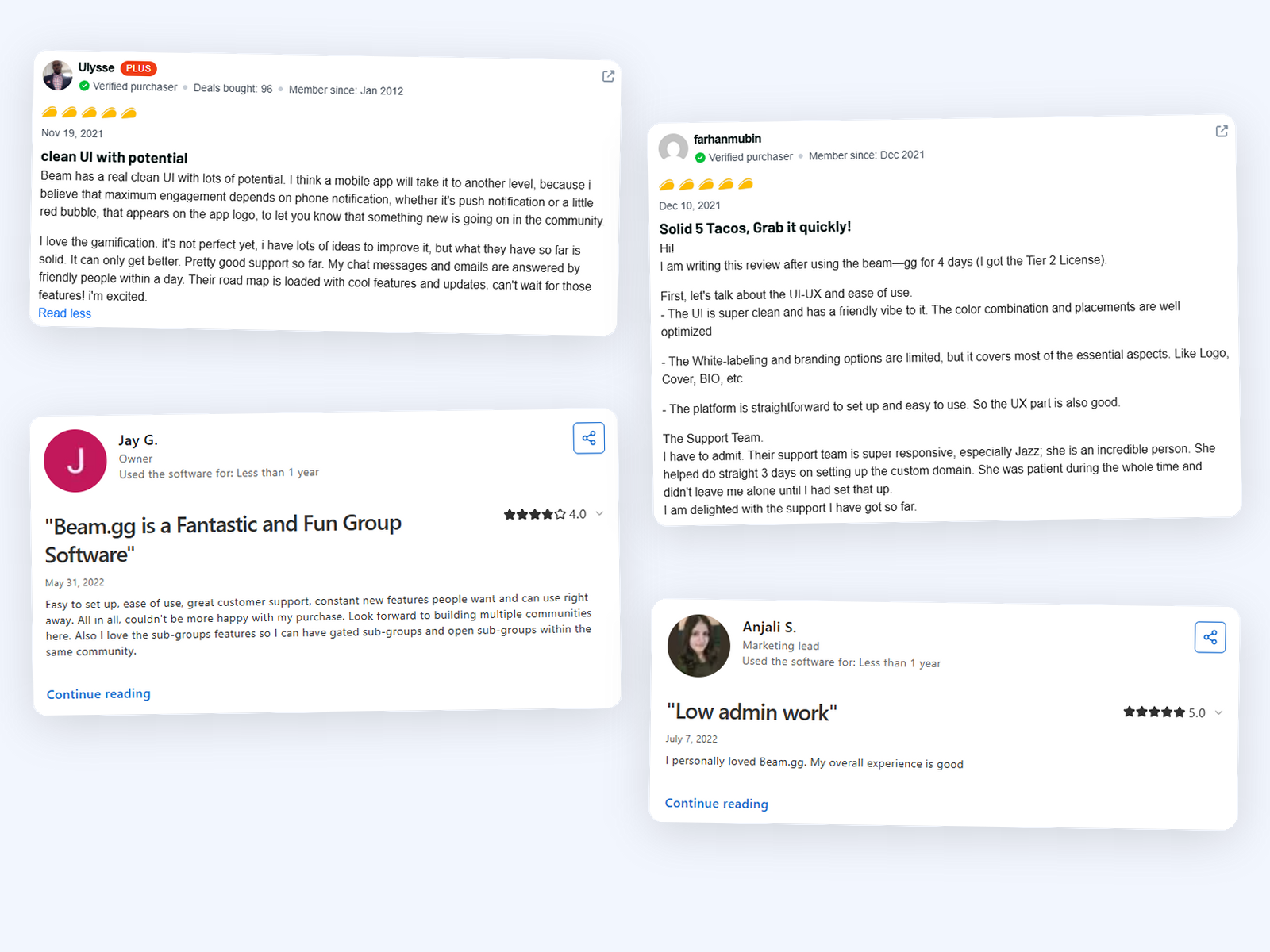
After this successful launch, we received an invite to participate in the AppSumo Select campaign, a curated campaign promoted by the AppSumo team to give products an even bigger spotlight. Only a few of the self listed products make it to the Select Campaign, so it was a great morale boost for the team and a big social proof that our product was heading in the right direction.
Looking back, we had a great product that did what the others overlooked.
It seems obvious to me today that gamification needs to be an integral part of any product or service that involves groups of people. Nowadays giants like Discord and Reddit lean heavily on gamification too, which only confirms the bet we made early on. You can also see these patterns in dating apps, marketplaces, sports apps, you name it. It’s clear to me now that having extrinsic motivators through gamification is a massively effective way of improving user retention and engagement.
What we failed to deliver was the customization for the gamification itself on the Business side. A common piece of feedback we had was that our customers wanted to have their own quests, profile unlocks and a way to increase experience gain, among others. It was a design oversight mixed with constraints of time and resources, but that is the one big thing I would’ve given a major focus if given a re-do.
With all of what I learned about gamification in this project, along with the experience of designing and prototyping an entire product, tackling and solving other problems like the APNG profile customizations, I’m excited to think about what projects I can bring this experience into next.
Also read the other Beam.gg studies, Product Design and Website and Brand Identity.